Followers

Powered by Blogger.
Monday, June 13, 2011

Year A - Proper 11, 16th Sunday in Ordinary Time (July 17, 2011)

Genesis 28:10-19a

This text needs a context to make sense.  Before hearing it, listeners need to be reminded of the feuding brothers we met last week and hear the story of Jacob and his mother tricking his father Isaac into giving him brother Esau’s blessing.  One way to do this is to invite the children forward and tell the story in your best storyteller style.  End with Rebekah hurrying Jacob away from the furious Esau out into the desert with directions to his Uncle Laban’s house – a long way away.  Then send them back to their seats to listen to what happened next as you read it from the Bible.


Genesis 28:10-19a and Psalm 139:1-12,23-24

Jacob says “Surely the Lord is in this place and I did not know it.”  The Psalmist says that God knows me completely and is with me wherever I go. 

Instead of gathering prayer concerns, gather where I will be or what I will be doing this week statements from worshipers of all ages.  Start it by describing briefly someplace you will be or something you will do during the coming week, then saying “Surely the Lord is in this place.”  Ask one or two others to say where they will be responding to each with “Surely the Lord is in this place.”  Then, hear statements from the congregation.  Depending on the number of worshipers, you (or the whole congregation) can repeat the phrase after each statement or wait until all the plans for the week are named before repeating the phrase for the group. 

The Runaway Bunny, by Margaret Wise Brown, is a conversation between a young bunny who is planning to run away and his mother who promises to come after him no matter where he goes.  In the end he decides he might as well stay home.  There is an easy connection between the mother bunny and God who comes after us and supports wherever we go.  It can be read aloud in 3 or 4 minutes - unless you take time to look at the art and ponder it a bit with worshipers. 

The book could be read as a bedtime story for Jacob as he falls asleep away from home with a rock for a pillow in the middle of the desert or it can be read as another poet’s version of Psalm 139.

Saint Patrick’s Breastplate is yet another way of saying what the psalmist says and what Jacob learned in the desert.  Introduce it to children by inviting them to copy your motions as you read it slowly.  Use it again at the benediction either leading the whole congregation in the movements or asking the children to come stand with you and lead the congregation in the benediction.

WWWWWWWWWWWWWWWWWWWWWWWWWWWWWWWWWW

Christ with me (hug yourself),
Christ before me (both palms up in front of you),
Christ behind me (arms behind you),
Christ in me (hands over heart),
Christ beneath me (spread legs and firm your stance),
Christ above me (hands over head),
Christ on my right (hand out to right),
Christ on my left, (hand out to left)
Christ when I lie down
       (make a pillow with your hands and lay your head in it),
Christ when I sit down (sit down),
Christ when I arise (stand up),
Christ in the heart of every man who thinks of me (point to head),
Christ in the mouth of everyone who speaks of me (point to mouth),
Christ in every eye that sees me (point to eyes),
Christ in every ear that hears me (point to ears).

WWWWWWWWWWWWWWWWWWWWWWWWWWWWWWWWWW


Romans 8:12-25

The idea of being a full member of God’s family is the most child-accessible idea in this passage.  Do not however, expect children to hear it as the text is read.  Instead, talk about what it means to be a member of a family.  On the good days family members take care of each other and enjoy being together.  Families make their home together.  Some families run a business together, some garden together, some share interests and concerns that they work on together.  They celebrate holidays and sometimes go on vacations together.  Even on the bad days, families take care of each other and work together.  If someone in the family gets sick or if there isn’t enough money, everyone in the family is involved.  Then read the Good News Translation of verses 14-17 in which the family language is much clearer.  The key points are

1.      God doesn’t say to us that we can be God’s slaves or servants or even that God will keep us around as long as we do well.  Instead God says that we are part of the family now and forever, no matter what.

2.      Because we are part of God’s family, we can expect to enjoy the happy days in the family.  But we must also be ready to stick with the family when the going gets hard.  We have to take care of members of the family who need us and we have to stand up for the family.  When I was growing up and wanted to do something that my parents knew I should not, I often said, “but all the other kids are….” to which my father frequently replied, “but you are not all the other kids.  You are a Carter girl and the Carters do not….”

If you are also reading the story of Jacob, point out that even after all he did God did not kick Jacob out of the family.  Instead, God promised to stick with him throughout his life and even told him that through him everyone in the world would be blessed.  Jacob is a good person to remember when we feel like we should be kicked out of God’s family.


Matthew 13:24-30,36-43

Before reading this parable, display a collection of photographs of blooming plants.  Ask worshipers to identify those that are flowers and those that are weeds.  Include a few like a dandelion that are familiar weeds.  But also include some questionable ones, e.g. Queen Anne’s Lace used to be considered a weed, but is now grown in some gardens.  Conclude that is very hard to know what is weed and what is a desirable flower.  Then read the parable.

Or, challenge a gardener to create a floral display in which weeds and flowers are intermingled.  During worship have a conversation with him or her about which are which.  Note how hard it is for most people, even good gardeners, to tell them apart.  Then read the parable.


Severus Snape
In the Harry Potter books there are several evil people (total weeds), but there are many more people whose loyalties are questionable.  Severus Snape was a teacher everyone hated and seemed often to be on the side of evil.  Repeatedly during the books, Dumbledore warns Harry that his dislike of Snape may not be fair.  In the end he is proven to be a hero.  Likewise, the whole Malfoy family (Lucius, Narcissa, and Draco) in the end is left among the bystanders.  They harbored serious prejudices against all who were not pure-blooded wizards and were allied with Lord Voldemort, but they loved each other and sacrificed to save others in several crisis situations.  J. K. Rowling, like Jesus, warns people not to write other people off as “evil weeds.”  In the parable Jesus insists that it is God who judges.  We are to withhold judgment because we cannot see everything.

Thursday, June 9, 2011

Year A - Proper 10, 15th Sunday in Ordinary Time (July 10, 2011)

Genesis 25:19-34

Children enjoy this story of brothers who were fighting before they were born.  Parents appreciate the story of the parents who did everything wrong by today’s standards for parents.  The whole family is a mess AND still God loves them and calls them to be God’s people.  There is a lot of hope in that for less than perfect families today. 
Do note that Joseph and the brothers who sell him into slavery show up the first two weeks in August.  Think ahead about which shared themes you will emphasize in these similar but different stories.

Ask a family with two sons who are good readers (maybe older elementary or middle school age) to read the scripted version.  Explain to them that their job is to help the listeners hear all the problems in this family.  Rehearse it with them once to show them where to stand and to encourage them to play their parts a little over the top. 

& & & & & & & & & & & & & &

Genesis 25:19-34

Reader 1 reads from the lectern and is probably the worship leader.  Isaac stands beside Rebekah in the middle, (maybe on the top step).  Esau and Jacob stand just in front of their parents (maybe one step down) and Esau closer to Isaac and Jacob closer to Rebekah.

Isaac  and   Rebekah
                  Reader 1
Esau            and                  Jacob


Reader 1:  These are the descendants of Isaac, Abraham’s son: Abraham was the father of Isaac,

Isaac (pointing to self):  Isaac was forty years old when he married

Rebekah (pointing to herself proudly):  Rebekah, daughter of Bethuel the Aramean of Paddan-aram, sister of Laban the Aramean.

Isaac: Isaac prayed to the Lord for his wife, because she was barren; and the Lord granted his prayer,

Rebekah:  and his wife Rebekah conceived.    The children struggled together within her; and she said, “If it is to be this way, why do I live?”   So she went to inquire of the Lord.

Reader 1:  And the Lord said to her,
“Two nations are in your womb,
and two peoples born of you shall be divided;
the one shall be stronger than the other,
the elder shall serve the younger.”

Rebekah:  When her time to give birth was at hand, there were twins in her womb.

Esau (pointing to self): The first came out red, all his body like a hairy mantle; so they named him Esau.

Jacob (raising hand as if to say that’s me): Afterward his brother came out, with his hand gripping Esau’s heel (Lean down to grab Esau’s heel then stand up again); so he was named Jacob.

Isaac (proudly):  Isaac was sixty years old when Rebekah bore them.

Esau (stand tall with feet planted wide):  When the boys grew up, Esau was a skillful hunter, a man of the field,

Jacob:  while Jacob was a quiet man, living in tents.

Isaac:  Isaac loved Esau, because he was fond of game; (Put hands on Esau’s shoulders)

Rebekah:  but Rebekah loved Jacob. (Put hands on Jacob’s shoulders)

Pause  (Parents withdraw hands and boys step forward a little)

Jacob:  Once when Jacob was cooking a stew,

Esau:  Esau came in from the field, and he was famished.   Esau said to Jacob, “Let me eat some of that red stuff, for I am famished!”

Jacob:  Jacob said, “First sell me your birthright.”

Esau:  Esau said, “I am about to die; of what use is a birthright to me?”

Jacob:  Jacob said, “Swear to me first.”

Esau:  So he swore to him, and sold his birthright to Jacob.

Jacob:  Then Jacob gave Esau bread and lentil stew,

Esau:  and he ate and drank, and rose and went his way. Thus Esau despised his birthright.

                                               Based on the New Revised Standard Version

& & & & & & & & & & & & & &

F Before reading this text, invite the children forward to explain what a birthright was.  From a preschool room bring a collection of plastic farm animals and housekeeping equipment.  Explain that when a man died in Bible days, all his stuff was divided among his sons (sorry, daughters).  The oldest son got twice as much as any younger son.  Identify several boys as brothers.  Give half of everything to one of them and split the rest between the others.  Note that since the oldest had more than he could possibly take care of, he COULD invite the younger ones to stay at home and help him.  But, he would be the boss.  Agree with the children that this was very unfair and you are glad it doesn’t work that way today.  Then, repeat the word “birthright” and tell the children they will hear about two brothers and the older’s birthright in today’s story.  Then send them back to their seats to listen.

D Children, who hear a lot about making good choices, enjoy hearing about Esau’s really poor choice.  Esau chose what he wanted right now without thinking about what he was giving up to get it.  Parents work hard to get children to avoid making that mistake.  And, throughout our lives we all struggle with what we want right now and what is of long term value.  Two books connect neatly here.

F Way back in the first Harry Potter book, Hagrid who loved magical animals got a chance to get a dragon egg.  He really wanted to raise a dragon.  He wanted it so much that he did not think ahead.  He ignored the fact that owning dragons was illegal, that dragons grow very fast, have poisonous fangs, nasty dispositions, and breathe fire.  (Hermoine had to remind him what was likely to happen to his wood house.)  And, there was trouble.  It soon became impossible to hide the growing, rambunctious dragon.  Finally, Harry, Ron and Hermoine managed to smuggle the dragon (Norbert) out of Hogwarts to people who could get it to a safe place.  But everyone got in trouble in the process.  Hagrid finally regretted getting the egg, just as Esau eventually realized that his choice to sell his birthright for a bowl of stew was very foolish.  Unfortunately for Esau, his bad choice had much more serious long term consequences than Hagrid’s did.  (See Harry Potter and the Sorcerer’s Stone, chapter 14, for all the glorious details.)

F In Alexander Who Use to Be Rich Last Sunday Judith Viorst describes a long series of bad choices a boy makes spending the dollar his grandparents brought him.  Alexander (yes, the same Alexander of Alexander and the Terrible, Horrible, No Good, Very Bad Day) really wants to save it for a walkie-talkie, but frithers it away foolishly.  Since the book was written in 1978, you may want to update the prices, e.g. no 11 cent candy bars.  Alexander and Esau both need help thinking ahead when they make choices.


Psalm 119:105-112

F This is the section of the huge alphabet poem Psalm 119 in which every line begins with the Hebrew letter nun.  Display a poster of the letter, explain that each line praises God’s word in a phrase that begins with that letter.  Project or show this text in a Hebrew Bible pointing to the letter at the right hand (Hebrew reads right to left) of each line.  Then have each verse read by a different reader.  This could be a good worship leadership job for an older children’s class.

F Verse 105 is probably the best known of these verses.  To help children understand the metaphor “Your word is a lamp to my feet,” try using a Bible as a flashlight pretending to look for something.  Maybe with the help of the children, conclude that a Bible will never be a flashlight.  Then read verse 105 and work out what it is really saying about the Bible.  The Bible helps us know where to go and what to do every day.  It helps us see God’s good way of living. 


Romans 8:1-11


J.K. Rowling (Harry Potter) and Paul are on the same page in this passage.  Paul compares living by the flesh with living by the Spirit.  Rowling gives us two characters to embody those possibilities. 

Lord Voldemort lives according to the flesh.  He is all about getting what he wants no matter what it means for others.  One thing he wants is to be immortal.  He learns that the way to do that is to divide his soul (his self) into seven parts, inserting each in a separate object that he obtains by killing its owner.  These soul holding objects are called horcruxes.  Slowly Lord Voldemort creates the horcruxes hiding them in ingeniously guarded places.  Murder and mayhem ripple out from his activities. 

Harry Potter on the other hand lives by the Spirit, that is he understands the world as a good place and sees love as what holds the world together.  He knows that he was loved so much by his mother that she died to save him.  He slowly learns to treat all the people around him lovingly.  He and his friends hunt and destroy each of Lord Voldemort’s horcruxes to save each other and everyone in the world.  When Harry learns that he is the final horcrux and that the only way to stop Lord Voldemort is to let him kill Harry, Harry allows that to happen.  That is living by the Spirit.  The surprise is that after his “death,”  Harry learns that he still has the opportunity to live and thus is returned to his friends.  His love triumphs over death.  This is living by the Spirit too.

Though we do not face death-eaters, magical monsters, and wizards with wands, we do daily meet opportunities to do what we know is wrong and will hurt other people.  We are warned by Harry to stay alert and be careful.

F If your congregation uses the phrase “renounce evil” in questions in baptismal, confirmation or ordination, quote those questions today.  Put the question into your own words with reference to Harry Potter’s fight against the evil he encountered.  Talk about what it means to “renounce evil” in each worship situation.  Compare “renouncing evil” every day to the way Harry had to “renounce evil.”


Matthew 13:1-9,18-23

F Parables are very open stories designed to have more than one meaning.  Often they mean different things to the same reader at different times.  When we refuse to offer right answers to the parables in preaching, we welcome worshipers to read and ponder all parables with a sense of open wonder.
The commentaries I read, warned against treating this parable as an allegory.  The easy way to do that is to read only the parable (verse 1-9) omitting the very allegorical interpretation in verses 18-23.  Or, stop after the parable to ponder “what Jesus was trying to tell us” before introducing verses 18-23 as one possible meaning.  Children are often more able than adults to produce possible messages.  If they do, be sure that their attempts are affirmed and not laughed at – even when their offerings are a bit novel.

F This parable (verses 1-9) begs to be dramatized for sheer enjoyment. 
 
Before worship gather a group of worshipers to prepare to pantomime the parable as it is read.  Read through the story first asking actors to show you how each seed grew.  As they offer good interpretations, assign them to that part.  After reading it through once and assigning parts, direct actors where to stand.  Then reread the parable with the groups miming their assigned parts.  Now you should be ready to pantomime it during worship.
- This could be done by youth and adults for a more polished performance or
- by children to give them a chance to be worship leaders and have a more spontaneous performance or
- by an intergenerational group for summer fun and to emphasize that the parable belongs to all of us.

Green plant sock puppet
choked by a weed sock puppet
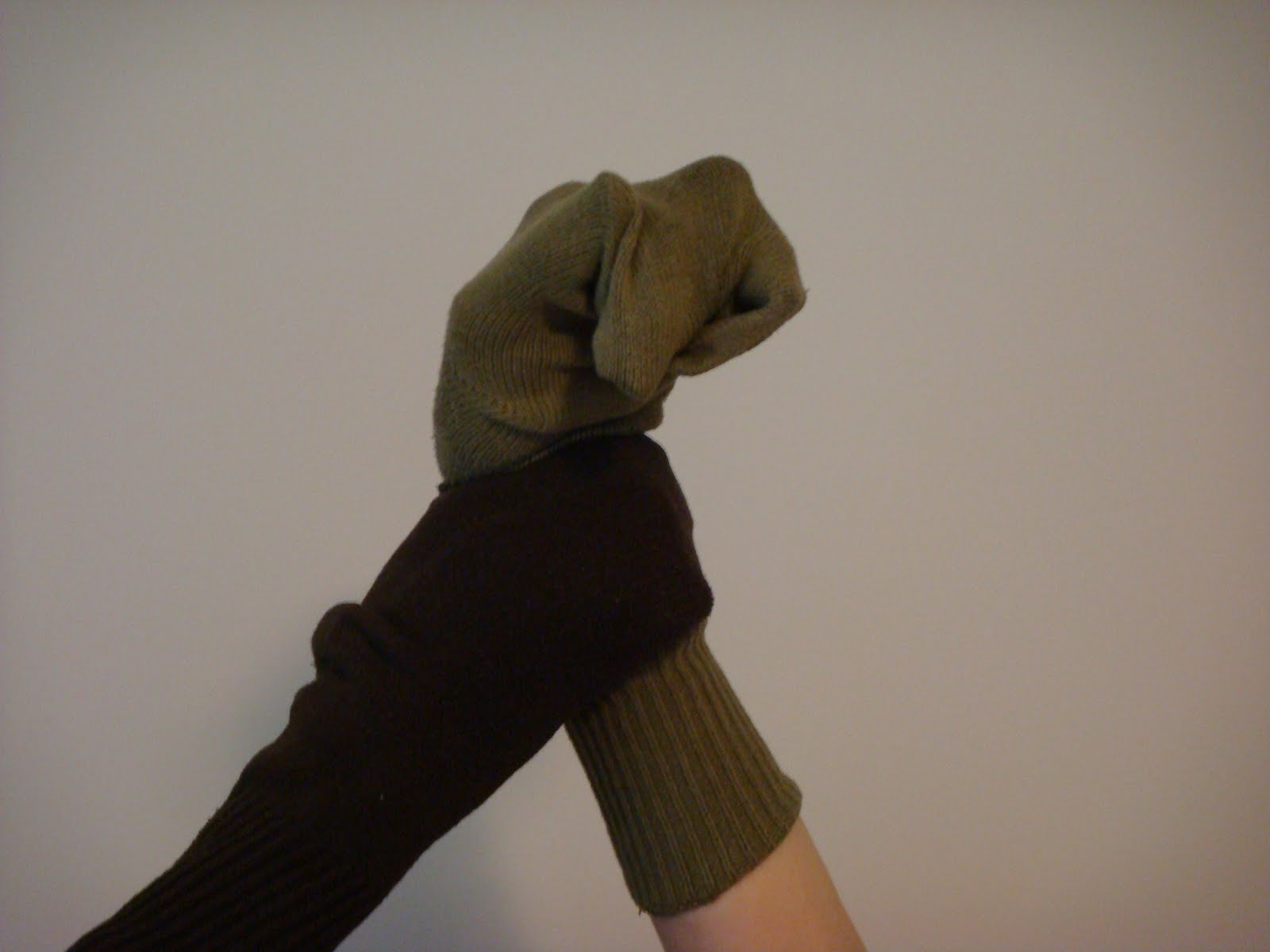
For a no rehearsal presentation using socks as puppets, invite the children to come forward to help you present the parable for the day.  Give each child one sock to pull over one hand.  Most socks should be green (or white with the instructions to imagine them green).  You will need a few dark brown ones for weeds and black ones for the thieving birds. There could even be a few gray ones for the rocks.  Once everyone has a sock on, invite them to show with their sock puppet what happens in the story.  You may need to pause as you read to help them act it out as you get started.

F The Harry Potter connection to this parable is found in Chapter 3 of Harry Potter and the Sorcerer’s Stone, “The Letters From No One.”  When his Uncle Vernon refuses to give Harry a letter addressed to him, more and more, actually hundreds of letters arrive.  As Uncle Vernon moves Harry and the family around hoping to make the letters stop, the letters keep arriving with the new address, e.g. “the cupboard under the stairs,” “the smallest bedroom,” “Railview Hotel,” and finally “the floor, Hut on the Rock, the Sea.”  The letter is an invitation to become a student at Hogwarts.  When Hagrid finally delivers it personally to Harry he tells Harry that he is a wizard, a much loved one.  Like the sower, Hagrid scatters his letters in abundance everywhere that Harry might get them.  Like the seed, the letters tell Harry who he is and invite him to an incredible new future. 

F Two other familiar children’s stories about sowing with abandon:
Miss Rumphius, by Barbara Cooney, tells the fictional story of a woman who keeps her promise to her grandfather to do something to make the world prettier by planting lupine seeds all around her community in Maine.

Go to http://www.appleseed.net/About_Johnny.htm to learn the details of the story of Johnny Appleseed, a real person who became a legend, for planting apple trees all over the Ohio River Valley and into New York.  After telling his story, sing the Johnny Appleseed blessing in place of the doxology today when offerings are presented today.
O, the Lord’s been good to me. 
And so I thank the Lord
for giving me the things I need:
the sun and the rain and the apple seed. 
The Lord is good to me.  Amen.
Saturday, June 4, 2011

Harry Potter and the July Worship Planner

The final Harry Potter movie comes out the middle of July.  There will be lots of hype – mild understatement!   Many  older children and Potter fans of all ages who have already read the books and seen the other movies will be rereading and reviewing them looking forward to this final installment.  Some will attend the movie dressed in costume.  In short, it is a big deal.

It is also a big deal that has some great connections to the Christian story and hence some possible worship connections.  I’ll point out some related to specific texts in the posts during July.  Here I am “popping off” about the overall themes.  I do this after reading two books which might be of interest.  Both talk above the heads of children but in so doing prepare us to talk with the children about this already classic tale.

The Gospel According to Harry Potter, by Connie Neal, was first published after book four was written to speak to Christians who wanted to ban Harry Potter claiming it directs children toward the occult.  She works through the details of the stories pointing out their decidedly Christian messages.  The Revised and Expanded Edition that came out after the final Harry Potter book adds events from the last three books. 

How Harry Cast His Spell, by John Granger (no relation to Hermoine in the bookJ) is more of the English teacher’s review of the Harry books.  He describes Harry Potter as following the classic English epic format (think Narnia or Lord of the Rings or even King Arthur).  Symbolism is explored in detail.  Characters are analyzed as mythic types.  I was fascinated, but children would be bored, even offended. 

After reading all the Harry Potter books over the years (and forgetting lots of the details), seeing all the movies (some more than once), and reading the two commentaries, I’d say….

$ The main attraction of Harry Potter for children is that a kid and his friends save the world.  True, they are young adults in the final book, but readers have claimed them as friends when they were ten year olds.  So, they feel like one of us – kids.  So it is possible to become one of the heroes as they are wielding wands and saving the world from the evil Lord Voldemort.  Perry Glazer of Baylor University put it this way, “Children need more than a set of virtues to emulate, values to choose, rules to obey, or even some higher form or reasoning to attain.  They long to be part of a cosmic struggle between good and evil.  And that is why children want to read Harry Potter.”

That by itself is worth a great deal.  But writer JK Rowling writes from a very Christian world view.  Some of her major themes preach.

$ The major theme is that love is more powerful than anything.  Harry’s mother’s love saved him from death as an infant and protects him throughout his life.  In love for his friends Harry does many very brave things.  Dumbledore explains to Harry that love is the one power Lord Voldemort simply doesn’t get and is indeed undone by.  He also says, “Do not pity the dead, Harry.  Pity the living and, above all, those who live without love.” 

The last book is filled with examples of Harry exercising the power of his love by taking big risks for those he despised.  He protects the Dursley family that kept him under the stairs, went back into a raging fire to rescue Draco Malfoy and Goyle, protected Draco from the death-eaters, and in their final encounter offers Voldemort a way out.  In the end, of course he allows himself to be killed when he realizes that his death is necessary for Voldemort to be killed.  (Much ink is being spilled about this as a Christ image, but for children, it is just giving yourself completely to save your friends and the ultimate act of love.)

$ Choices matter.  Dumbledore instructs “It is our choices, Harry, that show who we truly are, far more than our abilities.”  Harry and his friends have to make repeated choices.  In each one they decide what kind of person they will be.  Whether they are making a choice about how they treat a friend in class or how to deal with a magical enemy in an enchanted forest, in each choice they decide what kind of person they will be.  At the beginning, Harry and Voldemort are both boys with very similar magical powers. Both were orphans.  Both were lonely.  Voldmort chose to try to make himself immortal even though it required the destruction of many people.  Harry chose to love the people around him and to take care of others.  In the final battle he chose to die in order that others would be able to live.

Over the course of the books, Harry becomes aware that he is “The Chosen One.”  But, it is clear that he has free will.  He must choose to do the brave, loving things needed to be “The Chosen One.”  At any point he could opt out.

$ The chief sin in the book is prejudice.  The Gryffindor students distrust all Slytherins.  Many wizards distrust all muggles (non-wizards), even half bloods (the children of a wizard and a muggle).  And, house elfs are oppressed by all.  In the end all these prejudices are proven false.  Much is also made of characters like Severus Snape whom everyone, including Harry, thought was evil, but who turned out to be on their side.  Turns out the rush to judgment is a problem even in the magical world.

$ In Harry Potter’s world there are no 100% saints or 100% bad guys.  Harry’s hero Dumbledore it turns out has done some awful things.  Harry repeatedly breaks rules and abuses his powers.  On the other hand, Draco Malfoy, who we love to hate, does not kill Dumbledore and steps in to protect others.  In the final scene Harry addresses even Lord Voldemort by his given name, Tom Riddle, and realizing that he is in many ways like him offers him the way out.  The way out is for Riddle is to “try remorse” for all the damage he has done.  Author Rowling says clearly that to be a mature human is to fail and to feel remorse.  Dumbledore can feel remorse.  Harry does.  Voldemort in the end cannot and is killed by his own killer curse.

$ In Harry Potter people grow and change.  Harry began as a frightened boy trapped under the stairs in the home of a family who dislikes him.  He has no idea who he is or what he is capable of.  Throughout the story he grows into a powerful, self-sacrificing hero.  And it is not just Harry.  Neville Longbottom goes from a timid soul who is the class joke into the one who leads the resistance at Hogwarts and kills the monstrous snake Nagini, Lord Voldemort’s final protector.  All this becoming-more-than-you-can-imagine feeds the hopes and dreams of children.  They too may become people who make a big difference for good in the world.

Without intending to, J.K. Rowling has provided us with sermon illustrations that preach.  Children, hearing us quote their literature, both conclude that they are a real part of the worshiping community and listen carefully to whatever point we make using the world of their hero Harry Potter.


$$$$$$$IMPORTANT WARNING$$$$$$$

The first Harry Potter book was delightfully scary to older children.  Each succeeding book of necessity becomes darker and scarier.  Harry Potter and the Deathly Hallows is a violent story and will probably be quite graphic on the screen.  The advertizing poster gives you a sense of how far we've come.  It is definitely not a film for children who have not already worked through the other books/films.  Be careful not to suggest to parents that this is a great family movie to take in unprepared. 

About Me