Followers

Powered by Blogger.
Thursday, October 21, 2010

Year C - 31st Sunday in Ordinary Time (October 31, 2010)


Talk about over load!  This Sunday is 31st Sunday in Ordinary Time (featuring the child friendly Zacchaeus story)-and All Hallows Eve.  Tomorrow is All Saints Day which has the appeal of celebrating Christian heroes and heroines.  Today is also Reformation Sunday (in the year of John Calvin’s 500th birthday) and it is of course Stewardship Season in many congregations.  There are all sorts of connections for children.

Halloween is the biggest thing on their agenda today.  The Habakkuk and Psalm 119 texts provide an opportunity to explore how we face our fears trusting God.

If you celebrate Reformation Sunday, talk about what a church is.

And, children love hearing the familiar story of Zacchaeus read and discussed in the sanctuary.  Hearing it there teaches them that this is not just a children’s Sunday School story, it is a story that is important to the whole church. 

Because children are into facing fears on Halloween and the current political campaigns are playing heavily on adult fears, I’m going to work with the texts for this day connecting to Halloween.  Please, use the comments section to share what you are doing and suggest other possibilities.

Habakkuk 1:1-4, 2:1-4
God will have the final word about all the evil and violence in the world

Habakkuk complains about the violence and injustice that are causing so much pain in the world.  He speaks in generalities about what everyone fears and then delivers God’s promise that the violence and evil will not be the final word.  On Halloween we practice facing up to our fears.  We tell scary stories, walk through haunted houses, and dress up as monsters.  Children’s Halloween picture books range from tales in which heroes rise above their fears and in the process prove the scary thing or place is not so scary after all to tales in which monsters are shown to be just like us.  (There is even a take-off on Good Night Moon called Good Night Goon in which a young monster says goodnight to all the scary-to-us stuff that is part of his everyday life and a similar take off on Runaway Bunny called Runaway Mummy.) 

Display a not-too-scary mask (remember it doesn’t take much to scare the youngest).  Handle it, describe how it might frighten you but then point out that it is just a mask and not all that scary.  Use this as an entry to identifying the things we really fear – bullies at school, that something bad will happen to someone we love, that we will get lost, that there will be a war where we live, that we will never be able to do what we want most to do…   If the children’s fears lead to talking about adult fears about jobs, the economy, world conflicts, etc. , the children learn that fear is part of life.  They will then be ready to hear God’s promise to Habakkuk and us in Habakkuk 2:2-4. 

Suggest that everyone in the congregation hold hands because you are going to talk about scary things.  Then start with Halloween-y things and progress to the violent scary parts of everyday life for people of all ages.  Read Habakkuk 2:2-4 again, explaining some of its meaning related to the fears you have named.  Shake hands loose or clap hands to celebrate not having to be afraid because God is with us and will not all the bad things have the last word.

Have this scripture read by two readers:  one reading Habakkuk’s story in 1:1-4 and 2:1-2a and the other reading God’s message in 2:2b-4. 

Display a large poster or some other item with an Alpha and Omega on it (maybe a stole or parament).  Explain its meaning and connect it with Habakkuk’s message.  Just as God was in charge at the beginning, God will be in charge at the end, so we don’t have to worry.  We can trust God.


The best Halloween hymn is “A Mighty Fortress is Our God.”  It was written by Martin Luther while he was hiding in castle from people who wanted to kill him.  Tell this brief story of its writing before singing it and encourage worshipers to watch for fear and trust words. 


Psalm 119:137-144
An Alphabet Poem about God’s Word
צַ
Psalm 119 is an acrostic, that is an alphabet poem.  Each line in each section starts with a word beginning with the same letter.  The lines in this section start with the Hebrew letter zade/tsade (צַ).  If possible show a Hebrew Bible opened to this psalm or print this passage in Hebrew in your worship bulletin and help people recognize the repeated letter. 

When reading the psalm, have the congregation say the Hebrew letter zade before each line is read.

Each line says something about the value of God’s Word.  Hebrew poets rhyme ideas rather than sounds.  So, they say the same thing over and over again in slightly different ways.  For example,
It is a beautiful day.
The sun is bright and there is not a cloud in the sky.
It is wonderfully warm and there is a pleasant breeze.
I wish every day were just like this one.
Then, read one or two of the lines about God’s Word to show their similarity. 

Challenge children (and others) to write an alphabet psalm praising God on Halloween or other days when we are afraid.  Below is an activity sheet for doing this using words that begin with the letter H in honor of Halloween.  (I hope someone can find better fear art to go with this!)

**************************************************************************

                                Write a psalm prayer about fear. 
Try some of           Make each line begin with H in honor
these words          of Halloween.                                        


Help
                        H________________________
Have

Hope
                        H________________________
Heal

Hallelujah
                        H________________________
Hear

Hide
                        H________________________
Happy

Hold
                        H________________________
How

Horrible


**************************************************************************


Isaiah 1:10-18

To understand Isaiah’s message one needs detailed information about worship in Old Testament times and then connect that message to our different form of worship today.  That is a tough task for children.  So I would tend to use the other Old Testament texts.  If you do work with this one, go straight to verses 17 and 18 with the children.  They are more direct and use more familiar words. 

If your congregation regularly uses the language about sins as scarlet being made white as snow, this is a good chance to explain what we are saying when we say that and then to use it in the usual way.  Bring something rough and deep red (even a wadded up ball of red Christmas foil) and something soft and white (maybe a white sweater or piece of white cotton).  As you discuss the colors, remember that most children would prefer red over white.  For them the stark difference between red (think red ribbons, Christmas, valentines..) and white (think white paper, white shirt, OK, maybe also snow, but… white is generally boring) is more important than the colors themselves.  Tie the difference in the colors to the different feelings we have when we are hiding sins and when we admit them in Psalm 32. 

Psalm 32:1-7    SIN    TRANSGRESSION   INIQUITY    DECEIT   GUILT

Psalm 32 in the New Revised Standard Version is a collection of words about sin used often in worship  but  nowhere else.  So, before reading it, list the words and encourage listeners to watch for them in the psalm and in other parts of worship today.  If this will be the focus of worship, give children red pencils with which to underline all the sin words they find in their printed order of worship.

2 Thessalonians 1:1-4, 11-12
Greetings to the saints in Thessalonica

Because there is so much for children in the other texts and themes for this day and because a preacher is likely to go many different ways using this text, I am going to leave it with you.  If you find a great connection for children, please share it with the rest of us in the Comments.

Luke 19:1-10
Zacchaeus

This is another text that can take worship leaders many different directions.  Themes that speak especially clearly to children include:
-     People CAN possible.  Zacchaeus changed.  You can change.  People around you can change. 
-     The best way to deal with a troublesome person or enemy is to become a friend.
We can follow Jesus’ example by eating with the lonely ones or inviting them to eat with us in the school lunch room.
-     Giving away money or stuff can save you (or bring happiness).  Jesus said that returning the money he stole and giving half of all he had to the poor was going “to save his life.”  Take time to define “save his life” to include bring happiness, peace, and a place among God’s people as well as eternal salvation.

Jesus and Zacchaeus get most of the attention in this story.  But the crowd is us and is worthy of our attention.  To explore their responses, enlist the help of a few youth or adults.  Their job is to show the crowd’s response at key points in the story using their faces and their whole bodies.  At the beginning of the story, they jostle with each other with knowing smiles to keep Zacchaeus at the back of the crowd.  The leader may take the role of Zaccheaus trying to get through or at least see through the crowd as he tells the story.  Have a step ladder or stool for him to climb.  Once he climbs it, the crowd shares satisfied smiles and maybe elbows each other to be sure everyone sees Zaccheaus up the tree.  As Zaccheaus tells of Jesus’ invitation, the crowd parts and Zaccheaus comes down from the tree and past them.  As he passes, the crowd shows their displeasure with arms folded across chests, frowns and silently shared grumbles.   Zacchaeus moves off to the side and tells the story of his response from there.  He then freezes the action, steps out of character and asks how the crowd might have responded.  With demonstrations from the actors, explore options such as disbelief (Zacchaeus couldn’t change!), disgust with Jesus for reaching out to such a sinner, or possibly amazed acceptance of what happened. It takes a minimum of three to form this crowd and can use as many as your worship space will allow.  This is a great opportunity to work with a youth class preparing a story that will be meaningful to them and allowing them to become worship leaders.

Rather than work with a group of actors, the preacher could use his/her own face and body to demonstrate the crowd’s reactions while talking through the story and its meaning.

If it’s still Stewardship Season in your congregation, take a look at Miss Fannie’s Hat, by Jan Karon.  Elderly Miss Fannie gives the best of her grand collection of hats to raise money to fix up the church.  When she goes to church hatless on Easter morning, she finds the church surrounded by blooming rose bushes purchased with funds from the sale of her hat.  She and those all around her find great happiness in her gift.  One hopes that Zacchaeus and some of the folks he refunded will share similar happiness.


Thursday, October 14, 2010

Year C - 30th Sunday of Ordinary Time

Joel 2:23-32

Maybe the best connection for children is the visions and dreams promised in verse 28.  Identify dreams as possibilities and ideas about what could be.  Martin Luther King’s “I Have A Dream” speech illustrates the importance of a dream in shaping life for both individuals and communities.  According to Joel such dreams are gifts from God and therefore should be valued and worked with. 

Two well known hymns that explore dreams and are very child accessible are “Be Thou My Vision” and “Open My Eyes That I May See.”  Before singing the latter put the chorus into your own words.  Clarify “illumine me” as give me your vision, let me hear your message, help me claim as my own your dreams for me and for the world.


Psalm 65
Thanksgiving for the Earth’s Bounty

There are so many random praises in this psalm that it is hard for children to follow.  They are most likely to hear one or two that make sense to them.  One way to focus their attention on these phrases is to provide them with a page with the words of all or part of the psalm printed in the middle.  (Choose a translation such as Today’s English Bible which uses words children understand more easily.)   Invite children to illustrate the psalm by drawing in the margins things they read about in the psalm or that the psalmist makes them remember with praise.  As they leave the sanctuary, take time to talk with those who worked on this project about what they drew and/or post their artwork on a special bulletin board near the worship space or outside your office door.


2 Timothy 4:6 8, 16-18

Tell the back-story before reading this text.  Invite listeners to imagine Paul sitting in prison in Rome knowing that he will probably soon be killed and writing his young friend Timothy whom he helped as Timothy started work as a minister.  Then read the message thoughtfully, imagining yourself writing the letter, pausing at points to search for the right words for what you want to say. 


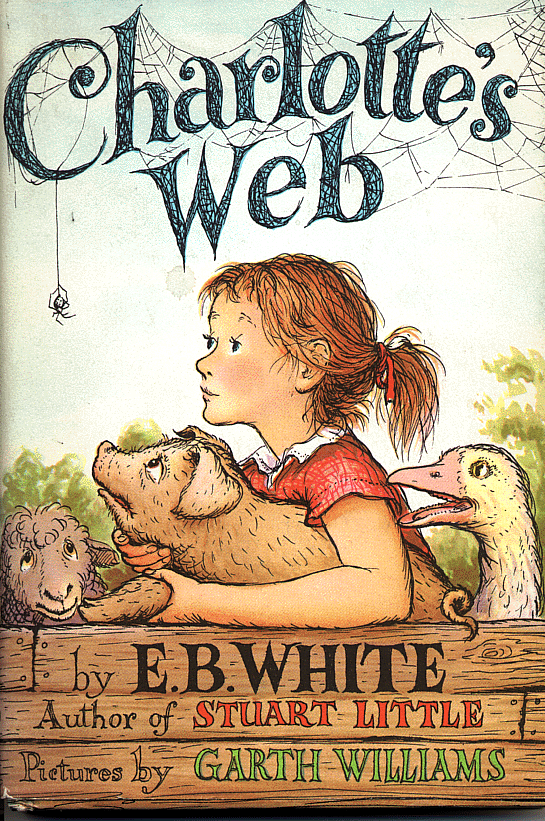
In Charlotte’s Web, by E. B. White, Charlotte the spider speaks shortly before her death to Wilbur who she mentored very much as Paul spoke to Timothy in this passage.  Click to http://storypath.wordpress.com/2010/10/08/lectionary-links-sunday-oct-24/ to get the details of this and check out a very useful new website connecting each lectionary text with a specific piece of children’s literature.


Luke 18:9-14
The Parable of the Pharisee and the Tax Collector

Two basic truths underlie the meaning of this story: God loves us and we are all sinners.  The Pharisee understands only one of them – God loves me.  He sees only his strengths and good deeds and tells God all about them.  It is a one sided conversation.  The tax-collector however understands both of them.  He is well aware of his weaknesses and sins.  (Lots of people point them out to him regularly!)  If that was all he knew, he wouldn’t be at the Temple at all.  But he also knows that God loves him in spite of his sins.  So he comes to God to confess and leaves OK with God.

To give the tax-collector’s prayer a physical reminder, put each truth in one hand then fold the hands together in prayer.  Either use your own hands or invite listeners to use their hands.  In either case, hold one hand palm cupped up to hold the truth that God loves us.  Briefly describe God’s creation of each one of us with our special gifts and talents.  Keep that cupped hand in place while raising the other hand up in the same position to hold the truth that we are each one of us sinners.  Move your hands up and down in relationship to each other to note that on some days we feel more loved and lovable and on other days we feel more sinful.  Then fold the hands together as if in prayer.  Jesus tells his listeners to be honest with God.  When we come to God honestly admitting our sins and trusting that God loves and forgives us, we are OK with God – and also OK with ourselves and the people around us. 

Instruct people to look at the other people all around them in the sanctuary - the people in their families, their friends, the people they know who they are but aren’t friends, and the people they do not know at all.  Then tell them that every one of those people is a sinner.  Each one says and does things that hurt others, themselves and God.  Sometimes they mean to do those things.  Other times the mean words and deeds just pop out.  Even they are surprised at what they have done.  Then direct everyone to look again.  Point out that God loves every one of the people in the room.  God made them and knows them, even the awful things they do, and God loves them.   When we are honest with each other and with God about both the awful things we do and God’s love for each one of us, things work out OK. 

This is more powerful for both the children and the rest of the congregation if it is done as part of the Sermon because children are part of the whole rather than a “we” looking at a “them.”  It also invites the adults to participate in the activity rather than observe it.

The unrecognized sin of the Pharisee was that he saw none of his own faults and all of those around him.  The old word for that is scorn.  The word is not familiar to children and there are few better substitutes, but there is plenty of scorn in their world.  To explore this scorn or looking down on others,

Quote and discuss common phrases, labels and names as examples:
You’re not as (good, fast, smart, pretty….)  as me!
You’re just a (jerk, baby, …ask the children to add labels used in their school)
Names that belittle – Shorty, Four-eyes, Pipsqueak, etc.
Be ready to discuss what is hurtful about the names and labels and think ahead about how you will handle terms with racial or sexual connotations.  (This could be a lead in to comments about the names and labels being hurled scornfully by both sides in the current election campaign.)


JESUS MAFA. The Pharisee and the Publican,
 from Art in the Christian Tradition,
a project of the Vanderbilt Divinity Library,
Nashville, TN.
http://diglib.library.vanderbilt.edu/act-imagelink.pl?RC=48268

Direct attention to the Pharisee’s hands in this African artist’s illustration of this story.  One hand says “look at me.  See how fine I am.”  The other says, “Look at him.  I am soooo much better than he is.”  His hands explain the look on his face.  This man thinks that he is always right, that his ways are the best ways, and that very few people are as fine as he is.  Jesus says that God is not impressed with this attitude.  Even though the man does some fine things on God’s behalf, God is not impressed.  (Either print this picture in the bulletin or enlarge it and post it at the front of the sanctuary.)

Read this scripture as reader’s theater with male readers.  The Narrator may read from the lectern with the other 2 at center front.  Or, all three may stand center front with the Narrator in the middle of the other two.  Or, the Narrator may be in the lectern, the Pharisee at center front and the Tax collector off to the side.

Narrator: He also told this parable to some who trusted in themselves that they were righteous and regarded others with contempt:  “Two men went up to the temple to pray, one a Pharisee and the other a tax collector.

Reader 1:  Pharisee, standing by himself, was praying thus, ‘God, I thank you that I am not like other people: thieves, rogues, adulterers, or even like this tax collector.  I fast twice a week; I give a tenth of all my income.’

Reader 2:  But the tax collector, standing far off, would not even look up to heaven, but was beating his breast and saying, ‘God, be merciful to me, a sinner!’

Narrator:  I tell you, this man went down to his home justified rather than the other; for all who exalt themselves will be humbled, but all who humble themselves will be exalted.”

                                                                                        New Revised Standard Version


Thursday, October 7, 2010

Year C - 29th Sunday in Ordinary Time (October 17, 2010)

Jeremiah 31: 27-34, Psalm 119:97-104 or Psalm 19 (alternate Methodist text), and 2 Timothy 3:14-4:5
The importance of God’s Word, the Bible

The key verse of the Jeremiah text for children is verse 33.  The day will come when God’s word will not be on stone tablets or in books, but written into our very hearts.   A few children will have experience with learning something by heart, i.e. memorizing it.  Timothy is instructed to be a faithful student and teacher of the Word.  Under that is the belief that to be a strong, true church a congregation must be made up of people who know their Bible well.  Both psalms celebrate the scripture.  For the sake of the children, I’d choose Psalm 19 and maybe even omit verses 1-6.  Explore the importance of scripture using some of the following:


-    Show a Bible that you have all but used to death.  Tell how you got it into this state and note that most of what has made this book so ragged is now so much a part of you that if the book fell apart completely, you’d still have most of it inside you.  Encourage others to use a Bible to pieces.


-     If there is a large Bible displayed and read from in the sanctuary that has a history, tell that story and bring it to where worshipers of all ages can see it during or after the service.

-     Identify all the places the Bible is used in worship.  You might even mark each Bible based part of worship in the bulletin with a small clip art Bible.

-     Encourage family Bible story reading.  Ask how many families read a story each night at bedtime.  Suggest that they start reading two stories, one of the usual ones and one Bible story.  Tell parents that they can usually trust their instincts selecting a Bible Storybook.  Those with sweet cartoony illustrations will likely tell sweet stories.  Those with violent action in most pictures will lean that way in story selection.  More damage is done by waiting to find the right Bible storybook than by starting in with one that you later abandon.  Getting started is what is important.  Two Bible story books that I often suggest to families are:
The Family Story Bible, by Ralph Melton
The Children’s Bible in 365 Stories, by Mary Batchelor

-     Pray for all the study groups and church school classes for students of all ages in your congregation.  Do so in a way that obviously includes children’s and youth classes.

-     Offer a charge and benediction something like this:

Raise a Bible above your head say,
Go home, find your copy of God’s word.  If you don’t have one, buy one.
Open it in front of you
Read it.  Think about it.  Talk about it.
Hug it to your chest.
Let it be written on your heart.  Let the story in it become your story.  Let it become your guide for living every day.   
Raising your other hand in blessing
And as you read, may God be with you and speak to you and call you.  May God’s Spirit work through these words to direct you, empower you, even comfort you.  And, may the peace of God be with you always.

Jeremiah 29:33
’s “God’s word written on our hearts” will need to be explained to literal thinking children.  They quickly understand that having a Bible isn’t worth much.  It is only when you read it and use it that it becomes yours.

Psalm 119 and Psalm 19 compare scripture to the sweetness of honey.  So, before reading one of these psalms or before a sermon about Scripture, give everyone a honey flavored hard candy to enjoy and as a reminder of the sweetness of God's word.

Psalm 19 ends with “Let the words of my mouth…”  If you regularly use this prayer in worship, point it out in the psalm and briefly explain what it means to pray that prayer in the spot you pray it in worship.


Genesis 32:22-31 and Luke 18:1-8
God’s wrestlers

Wrestling with God is an intriguing idea to most children, especially most boys.  The story of Jacob wrestling with God all night not only gives them permission, it invites them to ask their toughest questions, argue with God about what seems “not right,” even fight back.  The idea that we can expect to wrestle with God and God’s direction all through our lives is probably new to most children.  Details in the story that are important to children are:
-     Jacob was strong enough and determined enough to wrestle all night long.  It would be great to be that strong.
-     At the end of the night God gave Jacob a name that praised him for struggling with God and being able to keep up the fight until dawn.  That means wrestling with God is OK.
-     Jacob is left with a limp for the rest of his life.  That demonstrates that struggling with God can be hard on you – but it is worth it.

Jacob wrestled with God all night.  The widow struggled with the unjust judge until he gave her justice.  Both had to stick with it in a long struggle.  Every kid who has asked repeatedly for something and been told “That is enough!” is drawn to Jesus using the woman who pestered the judge until he did what he did not want to do just to get rid of her.  Jesus’ message is that there are times when being a pest is exactly what is needed.  This is an opportunity to tell stories about the church being a pest working in the community on behalf of those whose needs are being overlooked by people in power. 

Outline all the wrestling that goes on in the process of a church mission project – maybe a Hunger Walk, a Habitat House, or a mission trip.  Point out the decisions that have to be wrestled with to get started, the problems that have to be resolved in planning, the strength required to carry it out, and the wrestling with what it might lead to next.  Note the many kinds of strength that are needed.  (It would be possible to link to the Bible theme here by exploring the importance of knowing our Bibles in these struggles.)

If it is Stewardship season, explore the way many of us wrestle with our money by reading all or part of Alexander Who Used to Be Rick Last Sunday, by Judith Viorst.  (Yes, this is the same Alexander of the Alexander and the Terrible, Horrible, No Good, Very Bad Day.)  The book describes all the foolish ways Alexander spent the dollar his grandparents brought him until he was left again with no money, only two bus tokens.  He struggles over every purchase.  Reading the whole book takes about seven minutes.  Since it gets repetitive, reading the first several pages would get everyone “into” the subject.  Reading it as part of the sermon teaches children that money is one of the things people struggle with at all ages.

Tuesday, October 5, 2010

Year A - Baptism of the Lord (January 9, 2011)

Isaiah 42:1-9

Isaiah’s description of the Suffering Servant of God has been seen as a either a description of or a job description for Jesus.  Walk through it verse by verse with children helping them understand some of the poetic images and connecting those images to stories about Jesus.  Point out that these were verse Jesus knew and may have thought about as he decided to be baptized and begin the work God asked him to do.


Psalm 29
The Voice of God in a Storm

In baptism the water is gentle.  In this psalm the water is a powerful thunder storm.  Just as God’s power is seen in baptism, so it is seen in the storm.  By celebrating the storm, the psalmist reminds us (and maybe himself) that God’s power is greater than and created the power of the storm (and all other powers of nature).  In the face of such power we are amazed, OK even scared.  My parents helped their children manage their fears of storms by comparing the thunder to God moving the furniture around up there or God bowling.  We kids quickly realized that these were not literal explanations of thunder, but ways to put thunder in its place within the loving power of God.  It became a storm game to come up with new things God might be doing to make all that noise.  Gathering other childhood explanations of storms can be a fun way to get into the psalmist’s frame of mind before reading the psalm.

Children enjoy knowing the path of the storm traced by the psalmist as it starts out over the sea, crashes into the mountains, and moves out into the distant desert.  To further celebrate storm power add storm sounds to the middle verses , leaving verses 1-2 and 10-11 unaccompanied as reflections on the storm.

-          Invite the whole congregation to become a sound orchestra tracing the storm.  One section snaps their fingers (the sound of the beginning rain).  A second section stands and slaps their hands on the backs of the pews in front of them (hard driving rain).  A third section lightly rubs their palms back and forth (rain receding into the distance).  A conductor rehearses each section, then directs them in and cuts them off as the whole congregation reads the psalm in unison.

 
-          Or, accompany the congregation (or choir) in reading the psalm with a variety of percussion instruments (snares, maracas, several kinds of drums, a rain instrument, even a gong for the height of the storm).  Percussionists will enjoy orchestrating themselves to follow the path of the storm.

Offer children a sheet of paper with the psalm printed in the middle.  Invite them to draw storm pictures all around it.  Especially those who live in the northern latitudes, may want to include blizzard as well as rain pictures.  A poetic worshiper might even undertake writing a blizzard psalm that could be enjoyed by the whole congregation later.  Suggest that worshipers put their posters somewhere where they can get them out when storms hit and they need to remember God’s power.


Acts 10:34-43
Summary of the life and ministry of Jesus

For children today is the hinge between all the Advent/Christmas/Epiphany of Jesus the Baby and the stories of Jesus the adult that will dominate worship from now until Easter.  They both enjoy and need help stringing the stories together so that they feel they know all of Jesus.  Peter’s sermon offers a good summary.  If you did not do this on the First Sunday After Christmas, today present a series of pictures of Jesus including birth, baptism, teaching, healing, calling fishermen or Zacchaeus, the cross, and resurrection..  Pictures may come from the church school teaching picture file, enlarged pictures from Bible story books or projected images collections.  As you present each picture ask who is in it and what they are doing.  This is both a chance to rehearse the whole story of Jesus and an opportunity for a little worship education about the seasons of worship.  Note how you celebrated birth at Christmas, will celebrate resurrection on Easter and will be telling stories about Jesus every Sunday between  Christmas and Easter.  (If you do this, look ahead to Jesus stories during the next few months to include in your summary story this morning.)

“O Sing A Song of Bethlehem” and “I Danced in the Morning” are songs that trace Jesus life and celebrate all of Jesus life on the day of his baptism.  Before singing one of them, point out the connection to Peter’s sermon and invite worshipers to follow the story of Jesus’ life in the verses.

The context of Peter’s summary of the gospel is preaching to the gentiles for the first time.  Peter prefaces his summary with “I realize that God has no partiality” or “I know now that God treats everyone the same” or “God doesn’t play favorites.”  There are better texts to explore this truth with children.  But, if that partiality is to be the focus of worship, explore it with children as follows:

-          Ask who God loves more
students with good grades or those with not-so-good grades
rich people or poor people
people who wear cool clothes or people who always look weird
athletes or nerds
Conclude that God made and loves all these people equally.  These people are God’s loved children.  We are to treat every person we meet as God’s loved child and we are to remember that we are God’s loved child.  (This could be developed into a low key anti-bullying pitch and/or remember who you are when you are being bullied pitch.)

-          Present pictures of children of many different cultures asking who God loves more.  National Geographic is one good source.  Portraits, by Steve McCurry, is a collection of 234 5 x 7 portraits of people from all over the world which can be ordered from Amazon.com.  In conversation make the points that God created and loves each person and that God wants us to treat each other with love and respect.

 
-          Dr. Seuss tells the story of a silly division between the star bellied sneetches and the plain bellied sneetches.  Both kinds of sneetches , like Peter, had to learn that they were all valuable.  Find this tale at the public library in Sneetches: And Other Stories, by Dr. Seuss.


Matthew 3:13-17
Jesus is Baptized

This text is an opportunity to talk about baptism in general as well as about Jesus’ baptism.  Show certificates of baptism.  Tell what baptism means in your congregation.  Walk through the baptism ritual explaining what each part means.  Sing any music that is generally sung at baptisms taking time to put it into your own words.  (Do this for the children realizing that many adults will be learning with them.)

If your congregation practices infant baptism and most baptisms are infant baptisms, this story introduces the idea that older folks can be baptized, too.  Tell the story of Jesus’ baptism.  Then, tell about an adult being baptized.  Note that when babies are baptized they do not understand what is going on.  Everyone else remembers that God loves us even before we can know it.  When youth and adults are baptized, they know what they are doing.  They decide to become followers of Jesus.  Be sure to point out that people who were baptized as babies, get their chance to say publicly that they want to follow Jesus when they are older and explain when that happens, e.g. in the Presbyterian church it is at confirmation .  (Do this for idealistic older children who are looking for a chance to take a public stand.  Be sure these children know that their parents have not robbed them of that opportunity and tell them when it will come.)

If your congregation does not practice infant baptism, you can go straight to the story about Jesus deciding to do what God asked and comparing it with the questions asked in baptism today. 

After exploring the story of Jesus’ baptism, invite worshipers of all ages to dip their hand into the filled baptismal fount and say to themselves, “I belong to God.”  This could be done as people leave the worship area.

In many congregations, new officers are installed in early January.  In this case, Jesus baptism links to their installation (maybe ordination too).  Jesus in being baptized is telling God and the people around him that he is ready to undertake God’s mission.  Officers are agreeing to undertake missions to which the church is calling them. 

About Me